How To Fix Your Attention Span (Before It's Too Late)
In 2004, researchers found that people spent an average of 2.5 minutes on one screen before switching their attention.
By 2012, it was 75 seconds.
Today?
47 seconds.
In two decades, our ability to stay on one screen has fallen by roughly 70%. And I don't think our brains suddenly became defective.
I think we trained them to become distracted.
I hate to admit it, but I noticed it in myself earlier this year.
I'm usually a disciplined and focused person, but I was stuck in a rut.
Work wasn't fun anymore, my energy was low, and I struggled to concentrate on what I needed to do.
I knew something had to change when I caught myself scrolling and realized I didn't even have the patience to focus on a 30-second video.
Years ago, that would have been unthinkable. It was also slightly embarrassing because I constantly tell people how bad scrolling is, yet there I was doing exactly that.
I felt like a hypocrite, and I was annoyed that I had allowed myself to get worse, so I decided to fix my attention span.
In this article, I'll show you how I did it. We'll look at how attention actually works, the forces that control your ability to focus, and the practical steps you can take to retrain it.
I'll keep it as short and concise as possible, so give me a few minutes and I'll show you everything you need to know to rebuild your attention span and take back control of your focus.
1. How Your Attention Actually Works
You become what you give your attention to.
— Epictetus
Let's start from first principles.
At any moment, there is far more information around you than your brain can consciously process. The words on this screen. The sounds around you. The feeling of your clothes. Thoughts about yesterday. Plans for tomorrow. The phone sitting next to you.
Your brain can't consciously process all of it at once.
So it has to choose.
Attention is what your brain allocates its limited processing capacity to.
Your attention span is simply how long you can keep those resources focused on the same thing before your attention shifts or starts to fade.
That's the first important distinction.
Another important thing to realize is that you don't have a fixed attention span.
You might struggle to read a book for 20 minutes, then watch a movie for two hours or play a game for four.
Clearly, your brain is capable of paying attention for longer than 20 minutes. The difference is the task. Some things are more interesting, stimulating, rewarding, or important than others.
A few main forces control your attention:
-
Reward: How rewarding is this?
-
Energy: How mentally tired am I?
-
Motivation: How much do I care?
-
Stimulation: How much is happening?
-
Difficulty: How much effort does this require?
-
Competition: What else could I pay attention to?
This explains why focusing on a difficult book becomes much harder when your phone is sitting next to you.
The book offers slow rewards for relatively high effort.
Your phone offers fast rewards for almost no effort.
Every time the book becomes slightly boring, your brain has a much easier alternative sitting within arm's reach. And when given the option, your brain will naturally default to the easier one because it requires less energy (which is beneficial for survival).
And this brings us to the real problem.
2. How We Trained Ourselves to Be Distracted
The chains of habit are too weak to be felt until they are too strong to be broken.
— Samuel Johnson
Your brain is constantly learning from what you do.
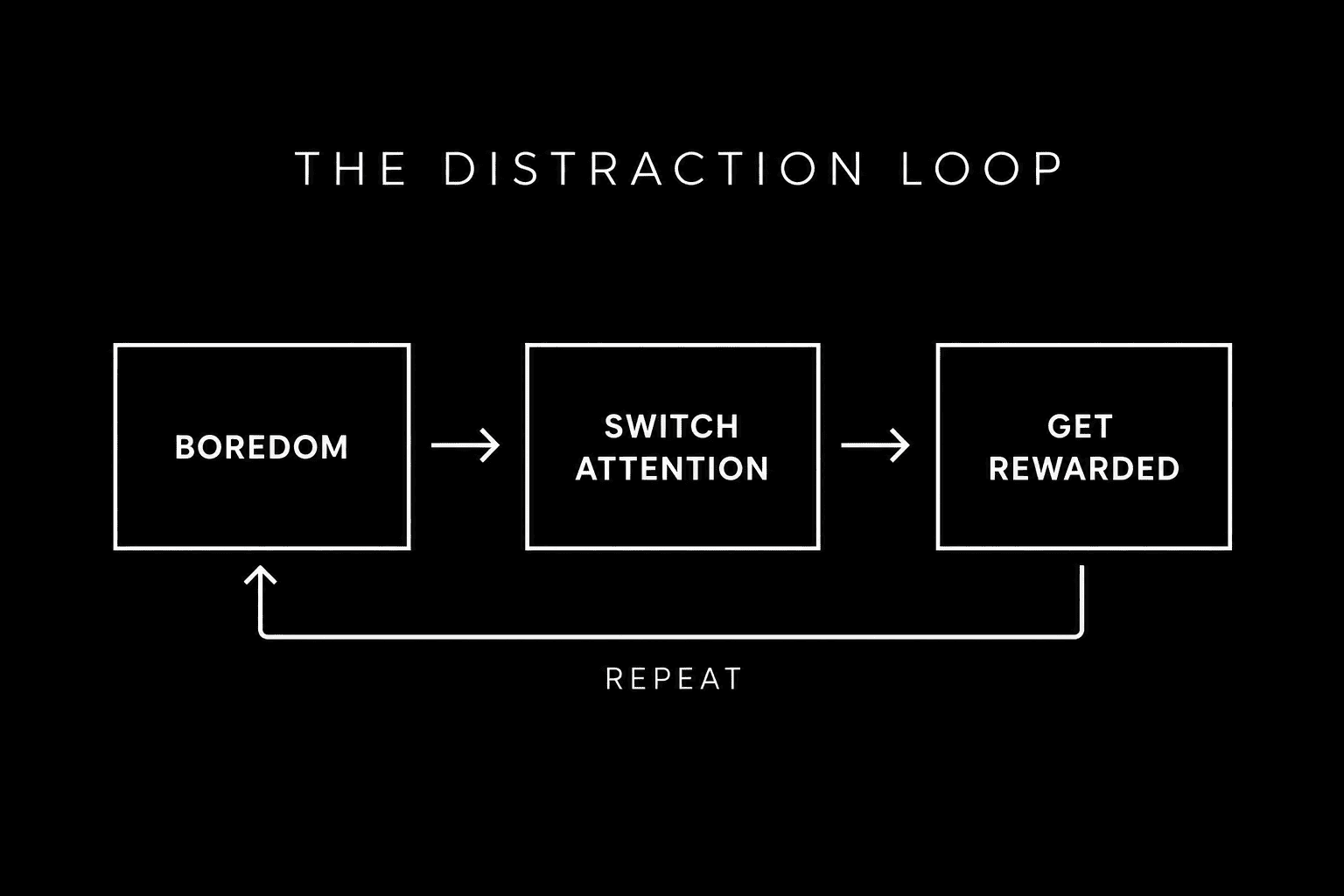
Imagine you're working on something difficult and you start to get bored. Instead of pushing through, you check Instagram and find something interesting within a few seconds.
Your brain just learned something:
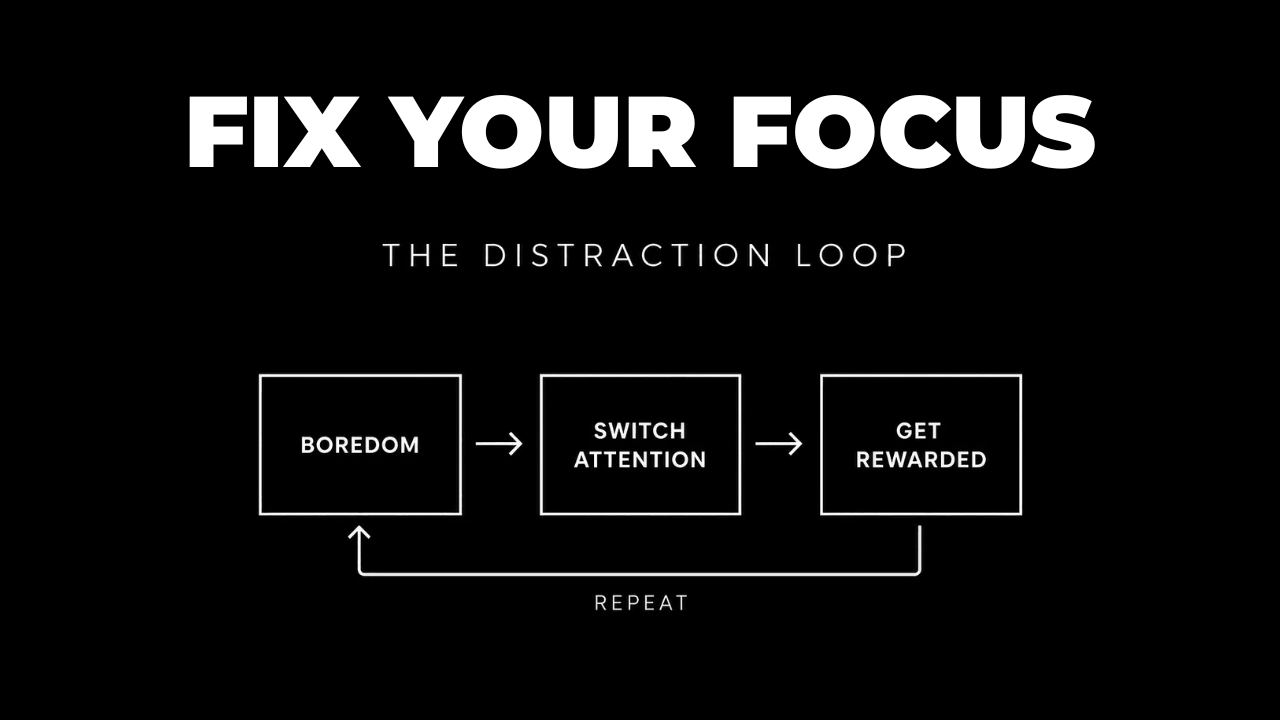
Boredom → switch attention → get rewarded.
This matters because rewards don't just feel good. They also shape what your brain learns to repeat. When an action leads to a reward, your brain learns from that experience and becomes more likely to pursue similar rewards in the future.
Dopamine plays an important role in that learning process.
Dopamine is often called the "pleasure chemical," but it's much more than that. It's involved in motivation, learning, reward prediction, and the pursuit of rewards.
That helps explain why something like scrolling is so effective at capturing your attention.
You don't know what the next post will be. It might be boring, but it could also be funny, useful, attractive, shocking, or exactly what you were looking for. The same applies to notifications, messages, videos, and most other forms of digital stimulation.
In other words, your phone gives you access to a constant stream of fast, easy, and unpredictable rewards. Research on dopamine and gambling helps explain why this kind of reward pattern can be so hard to resist.
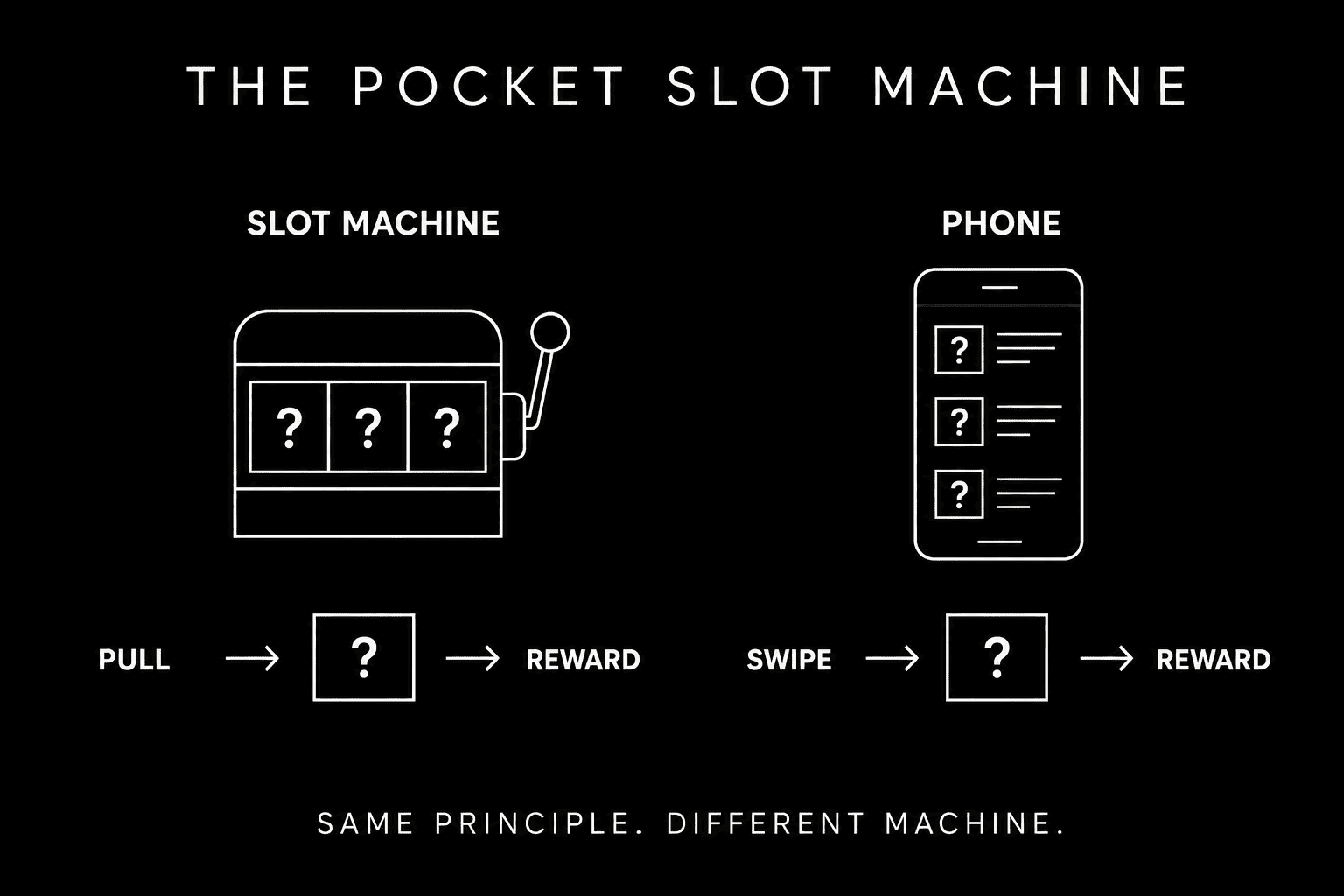
The problem becomes clearer when you compare this to the things you actually want to focus on.
Reading, writing, studying, working out, and meaningful work usually require more effort and offer slower rewards. You might write for an hour before you feel any real sense of progress, while your phone can give you something interesting within seconds.
So every time work becomes difficult, your brain is comparing two options:
1) Keep going and wait for the reward.
2) Switch to something easier and get rewarded almost immediately.
If you choose the second option often enough, your brain starts to learn a simple lesson: when something becomes boring or difficult, switching your attention is worth it.
And every time you do that, you reinforce the behavior.
Do this hundreds of times per week for years and you're not just wasting time on your phone. You're training yourself to respond to boredom by escaping it.
This is why slower activities can gradually become harder to tolerate.
Reading starts to feel boring. Writing feels more difficult. Work feels painfully slow. Eventually, you might even find yourself skipping through a 30-second video because waiting for the interesting part feels like too much effort.
It's a serious problem. But it also points toward the solution.
If constant stimulation can train your brain to become more distracted, reducing that stimulation can help train it in the opposite direction.
That's the good news about your attention span. You didn't suddenly lose your ability to focus. Your brain simply adapted to the way you've been using it.
Let's talk about how you can do this.
3. How to Retrain Your Attention Span
The more disciplined your environment is, the less disciplined you need to be.
— James Clear
Now that you understand how attention works, fixing it becomes much simpler.
You don't need another productivity hack. You need to reverse the conditions that trained you to become distracted in the first place.
Here are the six things that helped me the most.
1. Reduce stimulation
The first thing I would do is some form of "dopamine detox."
The term isn't ideal because you're not actually detoxing dopamine, but it's still a useful concept.
The goal is to make low-stimulation activities more engaging. To do this, we need to remove or reduce low-effort and high-stimulation activities.
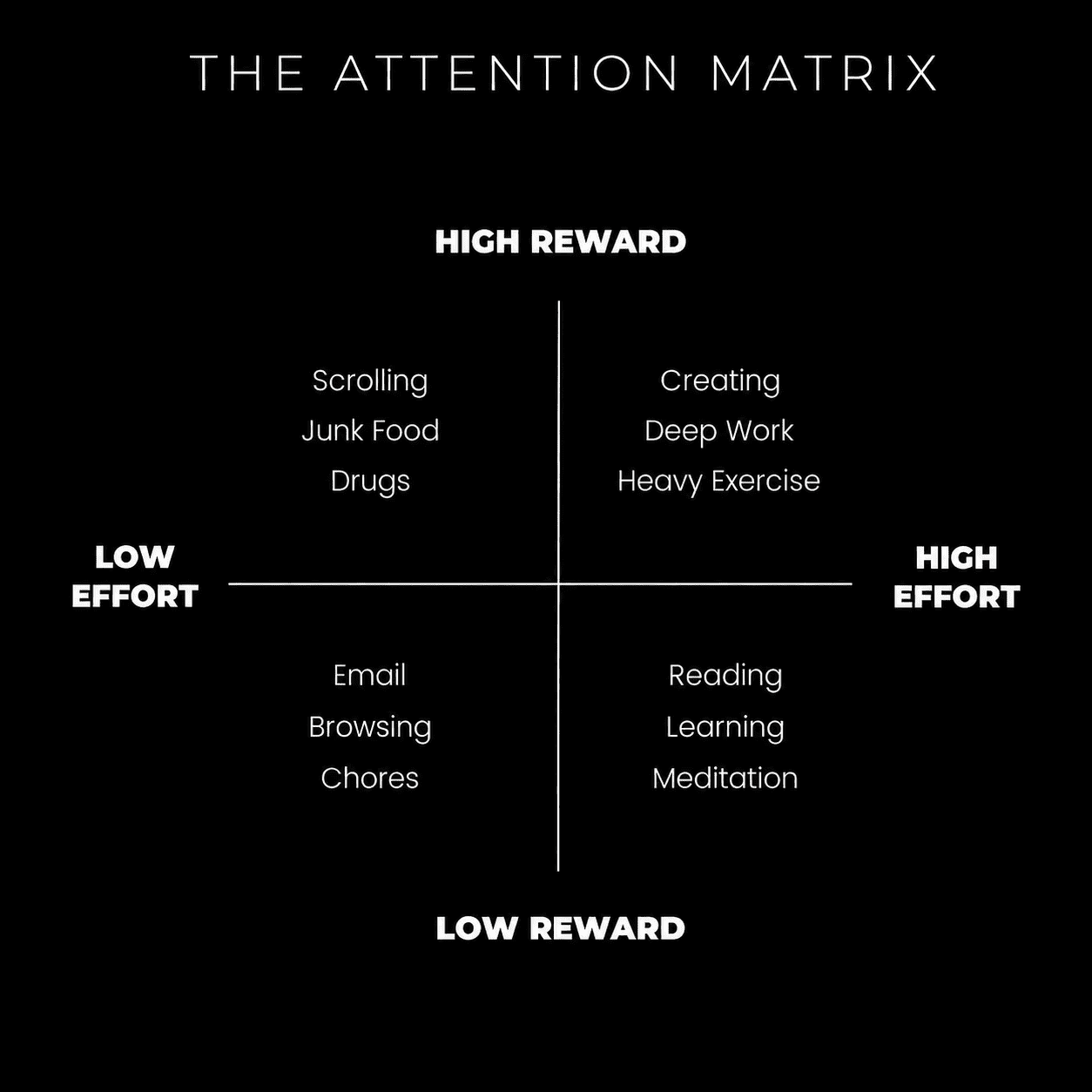
The biggest things to reduce or eliminate are:
-
Porn
-
Scrolling
-
Gambling
- Junk food
-
Excessive gaming
- Alcohol and drugs
-
Constant entertainment
-
News and mindless browsing
You don't have to quit everything forever. But if your attention span is terrible, I think it's worth becoming extremely strict for a while.
Make your life simple.
Work. Read. Write. Train. Walk. Eat. Socialize. Build something.
At first, it will be boring. Reading a book isn't as stimulating as scrolling or playing video games. But if you remove those options, then reading suddenly becomes more interesting.
That's the power of reducing stimulation. It makes the important things in life more stimulating so you'll be more likely to do them.
2. Remove distractions
Environment is the invisible hand that shapes human behavior.
— James Clear
Reducing stimulation changes what you consume.
Environment Design changes what you have access to in the moment.
Don't just rely on willpower to resist distractions. Make them unavailable.
Put your phone in another room when you work. Turn off notifications. Close unnecessary tabs. Keep your workspace clean. Log out of your social media accounts. Do one thing at a time.
Remember the definition from earlier:
Attention is what your brain allocates its limited processing capacity to.
Every additional option is competing for some of that attention.
The fewer things your brain can switch to, the easier it becomes to stay with the thing in front of you.
3. Get bored again
All of humanity’s problems stem from man’s inability to sit quietly in a room alone.
— Blaise Pascal
This was surprisingly important for me.
Most people barely allow themselves to be bored anymore.
We scroll while waiting. Watch something while eating. Listen to something while walking. Check our phones between sets at the gym.
Even our "breaks" are filled with stimulation. So we rarely practice being alone with our thoughts anymore.
Start doing that again.
Go for a walk without your phone. Eat without watching anything. Train without constantly checking something between sets. Stand in line without pulling out your phone.
Sometimes, just sit there and do nothing.
This retrains the loop we talked about earlier. Your brain stops craving stimulation when you're bored. And this has an interesting side effect:
If your breaks are stimulating, work feels boring by comparison.
But if your breaks are boring, work starts to become more interesting.
Master the art of being bored. It'll make you more productive.
4. Train sustained attention
The sun’s scattered rays are too weak to start a fire, but once you focus them with a magnifying glass, they will bring paper to flame in seconds.
— John Maxwell
Removing distractions isn't enough. If you want to become better at focusing, you also need to practice focusing.
Pick one thing and stay with it for a predetermined amount of time without switching.
If your attention is terrible, start with 20 or 30 minutes. Then gradually work your way toward 60, 90, or however long makes sense for you.
Reading is one of the simplest ways to practice this. A physical book gives you one thing to pay attention to without notifications, links, tabs, or an algorithm constantly offering you something new.
Meditation works for a similar reason. You notice when you lose focus and deliberately bring it back. This also makes it easier to control your attention while you work.
But my personal favorite way to train my attention is writing.
Writing forces you to slow down, think clearly, and hold your attention on an idea long enough to make sense of it. You don't even have to publish what you write. Open a document, pick an idea, and try to explain it.
Writing in the morning is my favorite part of the day so I can highly recommend it.
If you want to improve your writing while training your focus, The Digital Writer teaches you my entire system for writing content that grows your audience. Click here to join the waitlist.Or start with the free Writer in a Week challenge to see if writing is for you.
But whether you start writing or not, the important part is that you practice focusing on one thing for longer.
5. Fix the fundamentals
There's also a less exciting part of the equation.
Your attention comes from your brain, and your brain works much worse when you're exhausted or stressed.
So don't ignore the fundamentals:
-
Sleep enough
-
Exercise regularly
-
Eat reasonably well
- Take proper breaks
-
Manage chronic stress
You can have the perfect productivity system and still struggle to concentrate after sleeping for only four hours.
Sometimes your attention isn't being destroyed by your phone.
You may just be tired. So take care of the fundamentals.
6. Find something worth focusing on
He who has a why to live for can bear almost any how.
— Friedrich Nietzsche
Focus isn't only about removing distractions. It's also about having something you actually want to give your attention to. Think about how easy it is to spend hours on something you're deeply interested in.
The same person who struggles to focus on work for 20 minutes might spend three hours researching a business idea they're excited about.
Their attention span didn't suddenly improve.
They simply care more.
That's why getting clear on what you want matters. It's easier to focus when you know what you're working toward. It still takes hard work to build something you love, but the tools will feel lighter in your hands.
If you're not sure what you want to focus on, I created The Purpose Planner to help you figure it out. It's a free system to clarify your vision, values, and goals so you know what to work toward.
Once you figure out what you want to do, everything else becomes easier. This includes fixing your attention span. It's easy to say no to distractions when you know what you want to do with your life.
Your attention is one of your most valuable resources.
Stop giving it away to whatever is best at capturing it.
Start giving it to the things and people that actually deserve it.
Thanks for reading. Talk to you in the next one.
– Stijn
PS: Click here to join the waitlist for a discount and bonuses when my new writing course launches. It teaches you all the writing strategies you need to go from 0 to 100,000 followers, 10,000 newsletter subs, and 100M views on X in a year without ads.
How I Can Help You
1. The X Growth System. How I grew from 0 to 64,000 𝕏 followers and +100M organic X views in a year.
2. The Digital Writer. Go from 0 to 100,000+ followers, 10,000+ email subscribers, and 100M+ views. Join the waitlist for exclusive bonuses.