How to Build a One-Person Creator Business in 2026
I've been a full-time creator for more than 2 years now.
It took a lot of effort, mistakes, and learning to get there. I've bought dozens of courses, hired multiple millionaire mentors, read dozens of books, experimented with different business models, and made more mistakes than I can count.
When I look back at everything I did, only a small part of it actually mattered.
The fundamentals of building a successful one-person business are surprisingly simple.
And with AI, they're easier to learn and execute than ever before.
The hard part is knowing what actually matters and how it all fits together.
That's what I want to show you in this video/article.
We'll break down the simplest path I know to building a 6-figure one-person creator business from scratch in five parts:
1) The Plan — How the numbers actually work.
2) Brand — What you want to be known for.
3) Content — How you attract and build an audience.
4) Offer — What you sell and why people should buy it.
5) Product — How you deliver the result you promised.
We won't use ads, cold outreach, or complicated funnels. I believe you can pursue your genuine interests and turn them into a business with content, newsletters, offers, and products. So that's what we'll focus on.
But before we get to the 4 pillars of your creator business, let's break down the math.
How To Make $100,000+ As a Creator
Learn to sell. Learn to build. If you can do both, you will be unstoppable.
– Naval Ravikant
Before we build anything, let's break down the math.
Our goal is to build a 6-figure creator business:
$100,000 per year = $8,333 per month.
$8,333 per month = $278 per day.
There are many ways to get there.
You could sell:
- 500 × $200 digital products per year
- 100 × $1,000 consulting packages per year
- 20 × $5,000 ghostwriting services per year
Or any combination of them.
For example: 10 ghostwriting clients, 30 consulting packages, and 100 product sales.
On a monthly basis, you would need roughly:
- 42 × $200 product sales
- 8 × $1,000 consulting packages
- 2 × $5,000 ghostwriting clients
That's all you need to build a 6-figure one-person business.
Most people assume you need a massive audience to make this much.
But you don't.
Let's say you sell a $200 digital product and your sales page converts 2% of visitors into customers.
To make 42 sales per month, you need around 2,100 sales page visitors.
That's not nothing, but it's certainly attainable.
If you're getting 1 million views per month, you need less than 1% of those people to visit your sales page.
For this, you simply need to build an audience with valuable content and turn a small percentage of that attention into customers.
That's the business we're going to build.
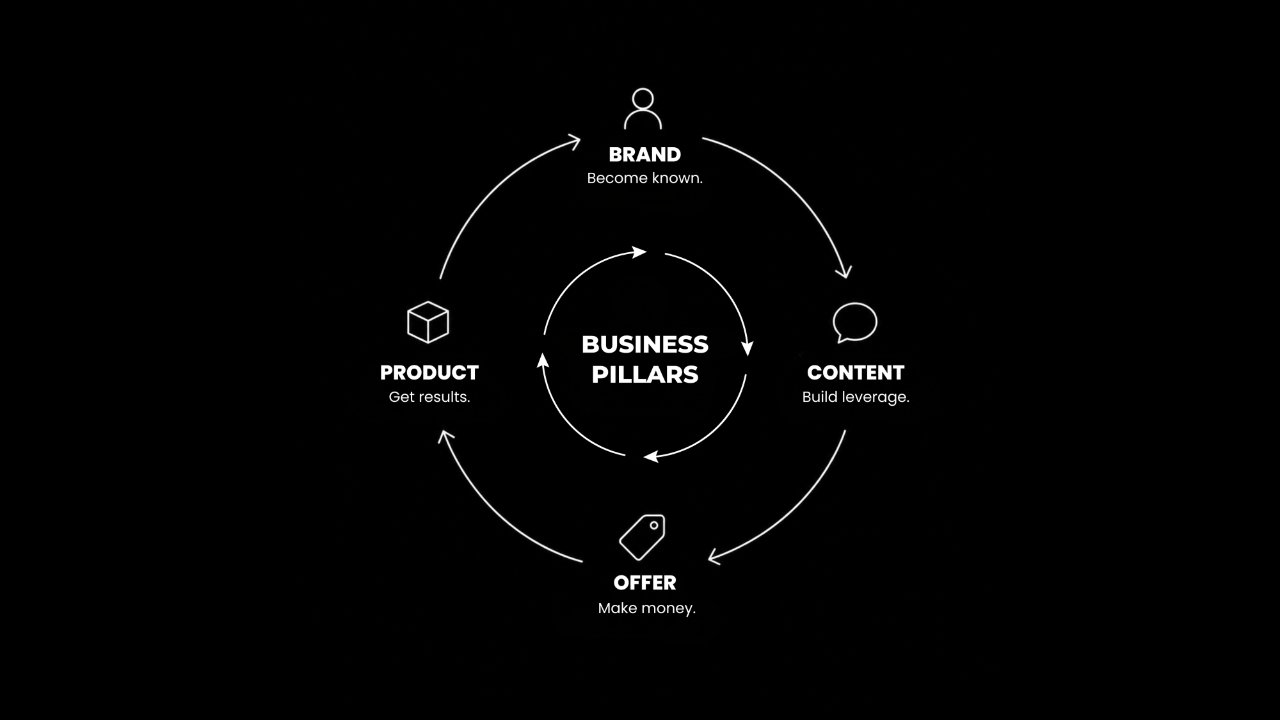
And it comes down to four core pillars:
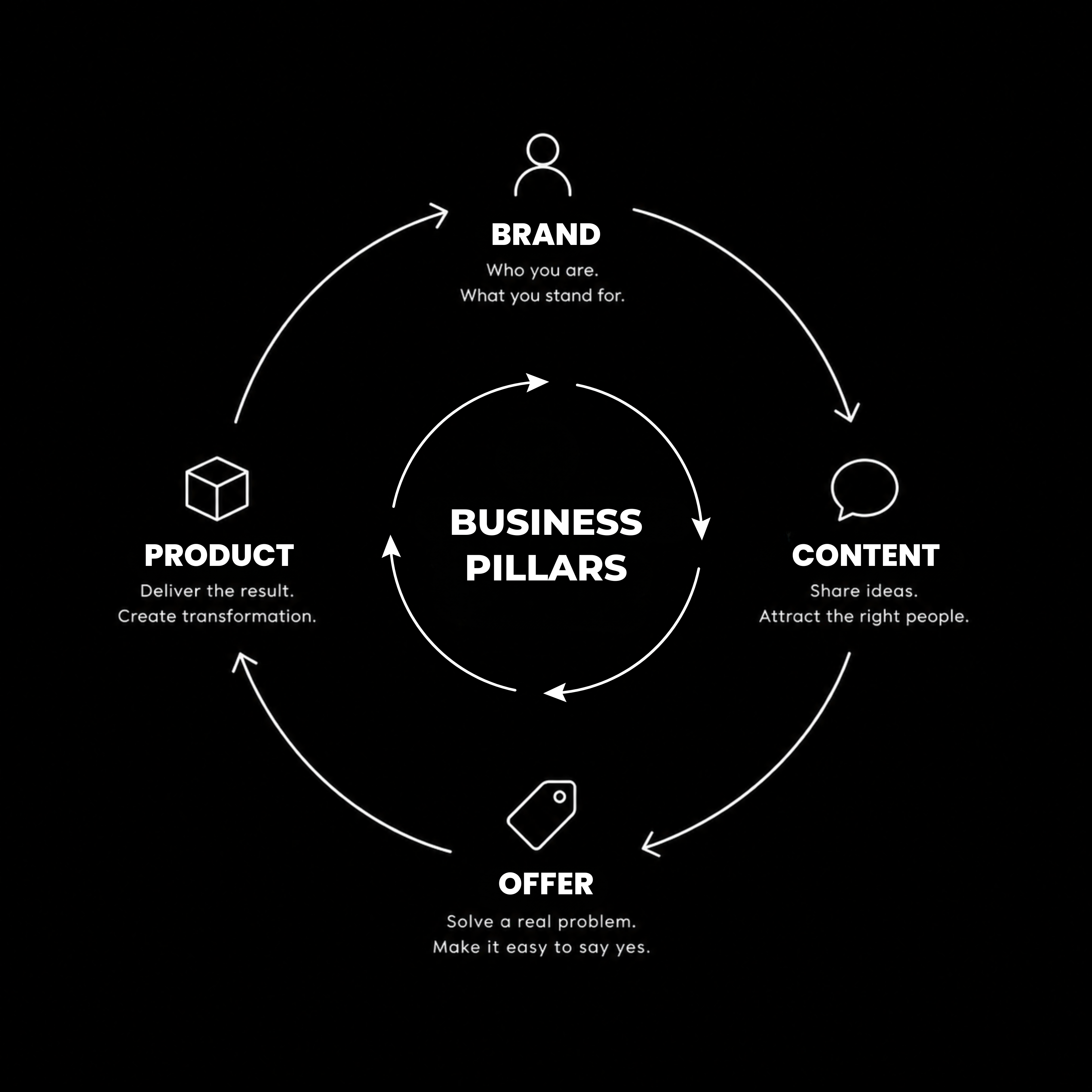
In short:
Brand → Content → Offer → Product
Those are the only 4 things you need to build a 6-figure one-person creator business. Let's start with the first pillar: your brand.
1) Brand: Become Known
Your brand is what other people say about you when you’re not in the room.
– Jeff Bezos
Your brand is the foundation of everything that follows.
It shapes:
- Who you attract
- What you talk about
- How people perceive you
- What people associate with you
- What offers make sense for you to sell
A strong personal brand starts with a few simple things:
1) Know who you want to help. You don't need a hyper-specific niche, but you should know what kind of person your work is for. You can create a customer avatar or you can create for your past self.
2) Know what you want to be known for. Pick a few core topics, skills, or interests you want people to associate with you. You can always change them later, but it's still useful to get clear on your core content pillars.
3) Have a clear point of view. There is unlimited information online. Your job is to remix the ideas and topics you love from your unique perspective. Your beliefs, experiences, opinions, and taste are what make your brand different from everyone else talking about the same topics.
4) Make your value clear. Someone should quickly understand who you are, what you talk about, and why they should follow you. Use your profile to make it clear how you can help them.
5) Build a recognizable identity. Your name, profile picture, bio, visual style, and voice should make your brand easy to recognize and remember. The goal is to get to a point where people recognize your content without even seeing your name.
6) Give your brand a direction. Have a bigger goal, message, or mission that ties everything together. What are you ultimately trying to help your audience achieve? Give people something to move toward with you. A strong “why” makes the “how” easier.
There's much more you can do, but this is 80/20.
The goal isn't to trap yourself in a narrow niche. It's to create a clear identity around your interests, expertise, and perspective.
Once that's clear, everything else becomes much easier.
You know what to talk about, who you're talking to, and what kinds of products or services you can create.
2) Content: Build Leverage
Give me a lever long enough and a place to stand, and I shall move the world.
– Archimedes
Leverage is getting more output from less input.
Content is one of the best tools to build leverage as a one-person business.
You can write something once and have 100,000 people read it. You can record a video once and have people watch it for years.
Every newsletter becomes an asset. Every video becomes an asset. That's the power of becoming an Asset Creator.
You do the work once. You reap the benefits for years to come.
Once you know what you want to be known for, your job is to consistently share useful ideas about those topics. If you do it well, you'll be rewarded with leverage (followers or subscribers).
That's what we use content for.
A few principles matter most:
1. Start with good ideas. Read, learn, experiment, reflect, and constantly capture ideas worth sharing. Think about your content as a body of work that keeps compounding.
2. Make the value obvious. People consume content out of self-interest. So show them how your ideas help them, what problems they solve, or what benefits they provide.
3. Study what works. Please don't try to reinvent the wheel. Research great hooks, titles, formats, and structures. Don't copy people, but learn to steal like an artist.
4. Practice a lot. You will be bad at first. That's how it's supposed to be. Content creation is a skill. The more you publish, analyze, and improve, the better you'll get.
As a one-person business, your time is limited.
So you can't create completely different content for every platform. I tried, and it's one of the things that led to burnout.
If you want to avoid burnout, you need a system.
My new content system looks roughly like this:
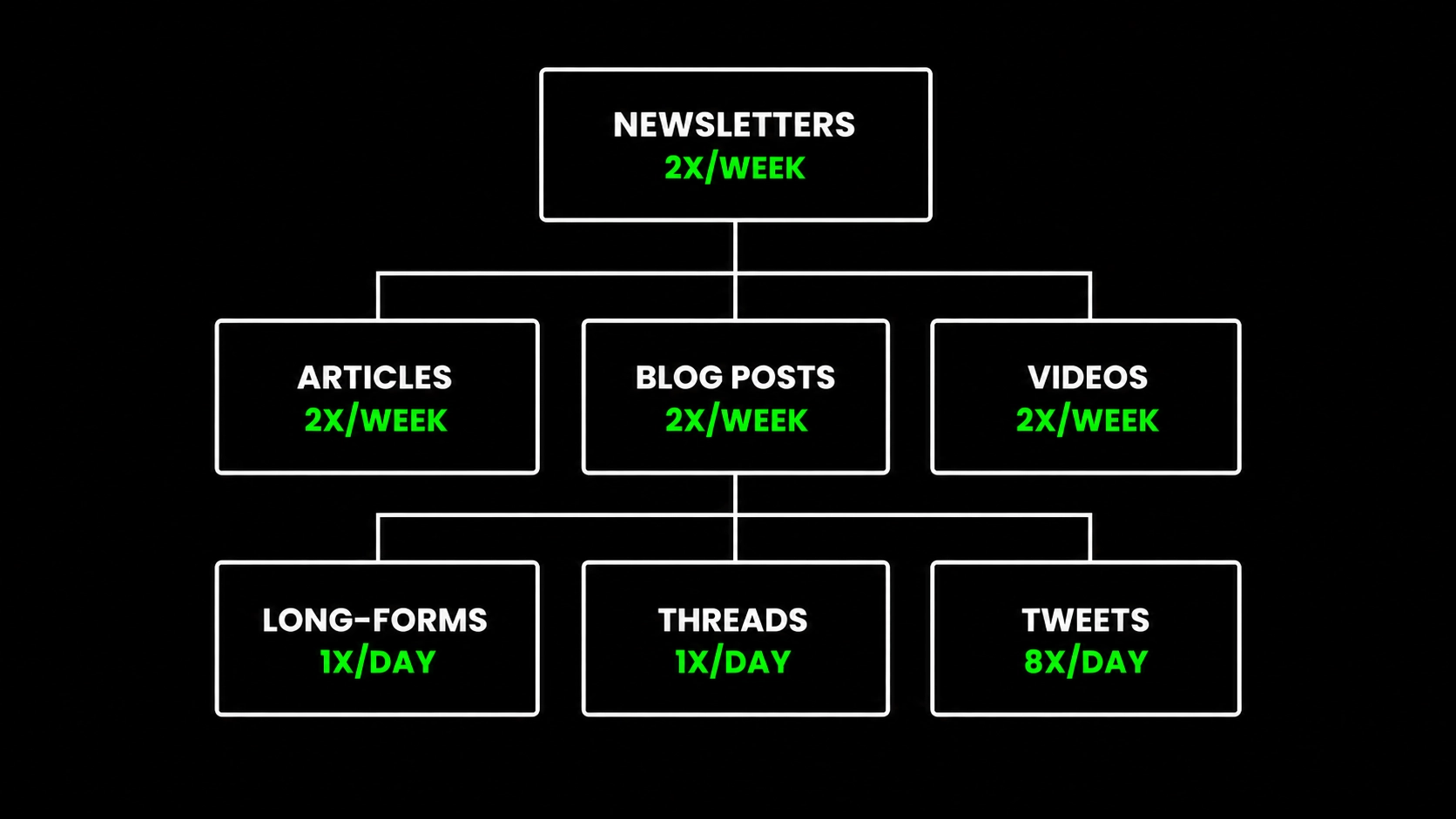
It looks like a lot, but it's simpler than it seems.
I focus on writing 2 high-quality newsletters per week.
Then I repurpose them:
- Newsletter → Article: I send it as an email and publish it on my blog, X, and Substack.
- Newsletter → Video: I use it as a rough script for YouTube, then publish the audio as a podcast.
- Newsletter → Social: I turn the ideas into long-form posts, threads, and short-form posts for X, LinkedIn, Instagram, Threads, and other platforms.
I also research high-performing content and capture new ideas throughout the week, which gives me additional posts and threads.
That's basically the system.
One good newsletter can become dozens of pieces of content.
This gives you two big advantages:
1. You can be everywhere without creating everything from scratch.
2. Every newsletter becomes an asset you can reuse, reference, and build on later.
Over time, your content starts to compound.
You build a library of ideas, attract more people, grow your newsletter, and create more opportunities to sell your offers.
This isn't a full course on content creation, so I won't go much deeper here. But if you want my complete system for finding ideas, writing content, repurposing it, and distributing it across platforms, you can find it here.
Content is crucial, but it only creates the opportunity to sell.
To actually make money, you need an offer people want to buy.
3) Offer: Make Money
Make people an offer so good they would feel stupid saying no.
– Alex Hormozi
An audience gives you attention. An offer turns that attention into money.
Your offer is more than the product you sell. It's the complete reason someone should buy it.
You could create the greatest product or service in the world, but if the offer isn't compelling, people won't buy it.
The key is understanding the difference between what people want and what they need.
Nobody wants a diet plan.They just want to get in shape.
The body transformation is what they want. The diet plan and workout routine are what they need to get there.
Your offer sells them what they want. Your product gives them what they need to achieve it.
A great offer needs 8 things:
1. A specific customer. Know who your offer is for, what they want, and what problem they want solved.
2. A desirable outcome. Give them a result they actually want. Sell the body transformation, not the diet plan.
3. A clear path. Show them how you'll take them from where they are now to where they want to be and how long it will take.
4. High perceived likelihood. People need to believe your solution will actually work for them. Proof, guarantees, expertise, and a clear process can reduce uncertainty.
5. Less time and effort. The faster and easier you can make the path to the outcome, the more valuable your offer becomes.
6. The right deliverables. Clearly explain what they get when they buy. This can include things like the course, coaching, support, templates, community, software, or any other resources.
7. A compelling price. The value of the outcome should feel significantly greater than what you're asking them to pay. Maximize the perceived value.
8. A reason to act now. Add real scarcity or urgency to give people a genuine reason to act instead of putting it off.
Put these together and you have the foundation of a compelling offer.
This is crucial to make sales, but your offer is still just a promise.
Now you need to build the product that delivers on that promise.
4) Product: Deliver Results
My recommendation is to spend less time on finance, spend less time in conference rooms, less time on PowerPoint, and more time just trying to make your product as amazing as possible.
– Elon Musk
Your offer gets people to buy. Your product determines whether they're glad they did.
I believe product is king.
Tesla is an extreme example. In 2022, Tesla generated $81.5 billion in revenue while spending just $175,000 on advertising. Instead of spending billions on ads like other car companies, Tesla focused on building the best possible products.
You probably won't build the next Tesla, but the principle is the same:
A great product makes everything else easier.
Better products → Better results → Better testimonials & word of mouth → Better offers → More sales.
A great product starts with the end result and works backward. Get extremely clear on the specific result your customer wants to achieve. Then map out the customer journey from where they are now to where they want to be:
Starting Point → Step 1 → Step 2 → Step 3 → Step __ → End Result
People buy your product because they want to transform in a specific way. Your product is simply the vehicle that helps them make that journey.
The goal is to make it as simple and effective as possible.
Look for ways to make it:
- Easier — Remove unnecessary difficulty.
- Simpler — Remove unnecessary steps and information.
- Faster — Help them reach the result sooner.
- Better — Help them get a more valuable result.
- Unique — Give them a new way to get there.
- More fun — Make the process more enjoyable.
It's important that you don't confuse more content with a better product.
Most people don't want 200 videos or 28 modules.
They want the result.
So keep your product simple and practical. Include what actually helps customers get the result and remove what doesn't.
Once you have that, get the first version into the hands of real customers.
Then use their behavior and feedback to improve it:
- See what they love
- See what they ignore
- See what results they get
- See where they get stuck
- See what they want more of
You don't need to build the perfect product on day one.
You just need to get the first version out there and improve it based on feedback.
It's important to keep doing this because a better product improves everything else:
Better Product → Better Results → Better Offer → More Sales
That's why product is king.
And that's the entire system.
Building a 6-figure one-person creator business doesn't need to be complicated.
You need four things:
- Build a brand people recognize.
- Create content to build leverage.
- Make offers people want to buy.
- Build products that deliver results.
Then improve each one as you go.
You don't need to do everything.
You need to get really good at the few things that matter.
That's how you build a one-person creator business that gives you freedom.
If you enjoyed reading this, subscribe to my free newsletter for more. You also get my Purpose Planner and Writer in a Week course for free when you sign up.
Thanks for reading. I’ll talk to you in the next one.
– Stijn
PS: Click here to join the waitlist for a discount and bonuses when my new writing course launches. It teaches you all the writing strategies you need to go from 0 to 100,000 followers, 10,000 newsletter subs, and 100M views.
How I Can Help You
1. The X Growth System. How I grew from 0 to 64,000 𝕏 followers and +100M organic X views in a year.
2. The Digital Writer. Go from 0 to 100,000+ followers, 10,000+ email subscribers, and 100M+ views. Join the waitlist for exclusive bonuses.